I felt disconnected from culture in 2025 and for at least a few years before that. I felt disconnected from my writing practice for a longer time still. I made the decision to force myself into a rhythm, a structure. For all my issues with grad school, it has heretofore been the time I felt the most intertwined with texts and ideas of interest. So, let’s try to have the good without the bad.
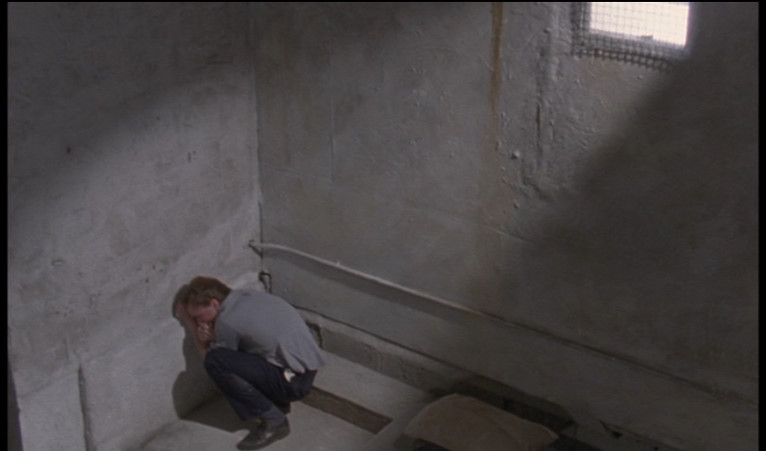
Peter Winter does not have a structure. To be more precise: Peter Winter scrambles forward with paranoid tunnel vision. A schizophrenic man looking for his daughter, he is scared of mirrors, of noises real and imagined, of the radio receiver in his head. Clean, Shaven does not offer respite from stress because Peter Greene’s performance is never still, and Lodge Kerrigan’s frames and sounds are legible without being typical. Greene scratches and rubs his shoulder in herky jerky thrusts inside a car covered in newspapers. Kerrigan frames Winter’s mother in an intense closeup that cuts off her face at the bridge of her nose. Snippets of radio transmissions (perhaps are they memories or hallucinations) score travel montages full of utility wires, recalling the experience of listening to the opening track of F♯ A♯ ∞ while staring at the album cover. The cluttered bric-a-bric strewn about and barren walls of the interiors recall Lynch.
Kerrigan is possibly the only director who found even modest success in the indie boom of the early 90s that either didn’t or refused to parlay that cache into a steady mid-major career. Outside of some television work in the waning of the Obama years, Kerrigan only directed three features, one of which remains undistributed. If his work could justify labeling Kerrigan as an iconoclast, what cult is he seeking to dismantle? A bit of vulgar materialism may grope towards an answer.
The Lynch echoes above come less from a deliberate homage than a quirk of economics. Eraserhead is the pinnacle of the silver age of American independent cinema. It is a moody picture full of handcrafted sets, psychosexual shadows, and pops, whizzes, and hums. Its economic similarities to Clean, Shaven suggest the micro-budget American feature serves as a conduit to an American unconscious. The cheapness reveals and wades in discomfort. These films are not the deliberate dialectic of European art films, but a rending of sublimated fears.
Due to the might of Hollywood in the first half of the twentieth century, and the limited state of public funding of the arts in the latter half of the twentieth century, American art films lack the philosophical bent of their European counterparts. Instead their bare bones budgets and outsider visionaries produce work that is more conversant with the traditions of folk horror, pulp literature, and beatniks. Clean, Shaven is more clean cut than, say, Carnival of Souls. It lacks the political punch of The Phenix City Story and the apocalyptic hammer of Detour. But the unease and spartan production carry on the best of Poverty Row and its ilk.
Back to the disconnect: I am not sure if American independent cinema has smoothed out the knotty exterior of its forefathers or if I am just no longer attuned to the channels through which such a product is now being distributed. Clean, Shaven was made for the same pennies as Detour but it was distributed by (pre-Shrek) DreamWorks. A24 DirectTV slop doesn’t quite fit the bill and the DTV actioners of Scott Adkins exist in a context of steroids and magnetic tape. A deliberate media consumption habit is a full time endeavor in a way I do not remember it as 10 years ago. Easy enough to chalk this up to age and 60-hour weeks. Still, the lack is never far from the front of my mind.
American indie film at its best freezes me in my chair (apologies for engaging in affect). The dissonance of familiarity of place and discovery of voice delights the mind. It’s seeing the seams on camera and thus seeing the seams that hold together our place in the world, our place in history. Our own sense of self is tattered and ripped. Peter Winter is a man who needs help, who is hunted by threats real and imagined, who is felled by the bruised ego of a state actor. There is no solace and the survivors are left haunted. What a picture.
 Fox Mulder Bat Flip